Insert multiple rows of data into a table

Question
In the previous exercise, you learned how to add a facility. Now you're going to add multiple facilities in one command. Use the following values:
- facid: 9, Name: 'Spa', membercost: 20, guestcost: 30, initialoutlay: 100000, monthlymaintenance: 800.
- facid: 10, Name: 'Squash Court 2', membercost: 3.5, guestcost: 17.5, initialoutlay: 5000, monthlymaintenance: 80.
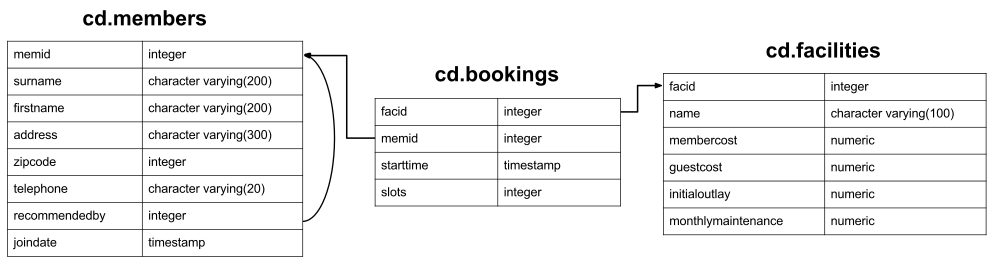
Expected Results
| facid | name | membercost | guestcost | initialoutlay | monthlymaintenance |
|---|---|---|---|---|---|
| 0 | Tennis Court 1 | 5 | 25 | 10000 | 200 |
| 1 | Tennis Court 2 | 5 | 25 | 8000 | 200 |
| 2 | Badminton Court | 0 | 15.5 | 4000 | 50 |
| 3 | Table Tennis | 0 | 5 | 320 | 10 |
| 4 | Massage Room 1 | 35 | 80 | 4000 | 3000 |
| 5 | Massage Room 2 | 35 | 80 | 4000 | 3000 |
| 6 | Squash Court | 3.5 | 17.5 | 5000 | 80 |
| 7 | Snooker Table | 0 | 5 | 450 | 15 |
| 8 | Pool Table | 0 | 5 | 400 | 15 |
| 9 | Spa | 20 | 30 | 100000 | 800 |
| 10 | Squash Court 2 | 3.5 | 17.5 | 5000 | 80 |
Your Answer
Your Results
Loading database...
Answers and Discussion
insert into cd.facilities
    (facid, name, membercost, guestcost, initialoutlay, monthlymaintenance)
    values
        (9, 'Spa', 20, 30, 100000, 800),
        (10, 'Squash Court 2', 3.5, 17.5, 5000, 80);
VALUES can be used to generate more than one row to insert into a table, as seen in this example. Hopefully it's clear what's going on here: the output of VALUES is a table, and that table is copied into cd.facilities, the table specified in the INSERT command.
While you'll most commonly see VALUES when inserting data, Postgres allows you to use VALUES wherever you might use a SELECT. This makes sense: the output of both commands is a table, it's just that VALUES is a bit more ergonomic when working with constant data.
Similarly, it's possible to use SELECT wherever you see a VALUES. This means that you can INSERT the results of a SELECT. For example:
insert into cd.facilities
    (facid, name, membercost, guestcost, initialoutlay, monthlymaintenance)
    SELECT 9, 'Spa', 20, 30, 100000, 800
    UNION ALL
        SELECT 10, 'Squash Court 2', 3.5, 17.5, 5000, 80;
In later exercises you'll see us using INSERT ... SELECT to generate data to insert based on the information already in the database.