Produce a list of all members who have used a tennis court

Question
How can you produce a list of all members who have used a tennis court? Include in your output the name of the court, and the name of the member formatted as a single column. Ensure no duplicate data, and order by the member name followed by the facility name.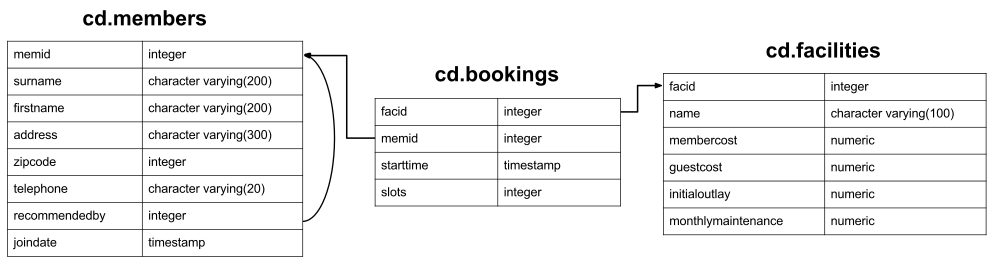
Expected Results
| member | facility |
|---|---|
| Anne Baker | Tennis Court 1 |
| Anne Baker | Tennis Court 2 |
| Burton Tracy | Tennis Court 1 |
| Burton Tracy | Tennis Court 2 |
| Charles Owen | Tennis Court 1 |
| Charles Owen | Tennis Court 2 |
| Darren Smith | Tennis Court 2 |
| David Farrell | Tennis Court 1 |
| David Farrell | Tennis Court 2 |
| David Jones | Tennis Court 1 |
| David Jones | Tennis Court 2 |
| David Pinker | Tennis Court 1 |
| Douglas Jones | Tennis Court 1 |
| Erica Crumpet | Tennis Court 1 |
| Florence Bader | Tennis Court 1 |
| Florence Bader | Tennis Court 2 |
| GUEST GUEST | Tennis Court 1 |
| GUEST GUEST | Tennis Court 2 |
| Gerald Butters | Tennis Court 1 |
| Gerald Butters | Tennis Court 2 |
| Henrietta Rumney | Tennis Court 2 |
| Jack Smith | Tennis Court 1 |
| Jack Smith | Tennis Court 2 |
| Janice Joplette | Tennis Court 1 |
| Janice Joplette | Tennis Court 2 |
| Jemima Farrell | Tennis Court 1 |
| Jemima Farrell | Tennis Court 2 |
| Joan Coplin | Tennis Court 1 |
| John Hunt | Tennis Court 1 |
| John Hunt | Tennis Court 2 |
| Matthew Genting | Tennis Court 1 |
| Millicent Purview | Tennis Court 2 |
| Nancy Dare | Tennis Court 1 |
| Nancy Dare | Tennis Court 2 |
| Ponder Stibbons | Tennis Court 1 |
| Ponder Stibbons | Tennis Court 2 |
| Ramnaresh Sarwin | Tennis Court 1 |
| Ramnaresh Sarwin | Tennis Court 2 |
| Tim Boothe | Tennis Court 1 |
| Tim Boothe | Tennis Court 2 |
| Tim Rownam | Tennis Court 1 |
| Tim Rownam | Tennis Court 2 |
| Timothy Baker | Tennis Court 1 |
| Timothy Baker | Tennis Court 2 |
| Tracy Smith | Tennis Court 1 |
| Tracy Smith | Tennis Court 2 |
Your Answer
Your Results
Loading database...
Answers and Discussion
select distinct mems.firstname || ' ' || mems.surname as member, facs.name as facility
	from
		cd.members mems
		inner join cd.bookings bks
			on mems.memid = bks.memid
		inner join cd.facilities facs
			on bks.facid = facs.facid
	where
		facs.name in ('Tennis Court 2','Tennis Court 1')
order by member, facility
This exercise is largely a more complex application of what you've learned in prior questions. It's also the first time we've used more than one join, which may be a little confusing for some. When reading join expressions, remember that a join is effectively a function that takes two tables, one labelled the left table, and the other the right. This is easy to visualise with just one join in the query, but a little more confusing with two.
Our second INNER JOIN in this query has a right hand side of cd.facilities. That's easy enough to grasp. The left hand side, however, is the table returned by joining cd.members to cd.bookings. It's important to emphasise this: the relational model is all about tables. The output of any join is another table. The output of a query is a table. Single columned lists are tables. Once you grasp that, you've grasped the fundamental beauty of the model.
As a final note, we do introduce one new thing here: the || operator is used to concatenate strings.