Retrieve the start times of members' bookings

Question
How can you produce a list of the start times for bookings by members named 'David Farrell'?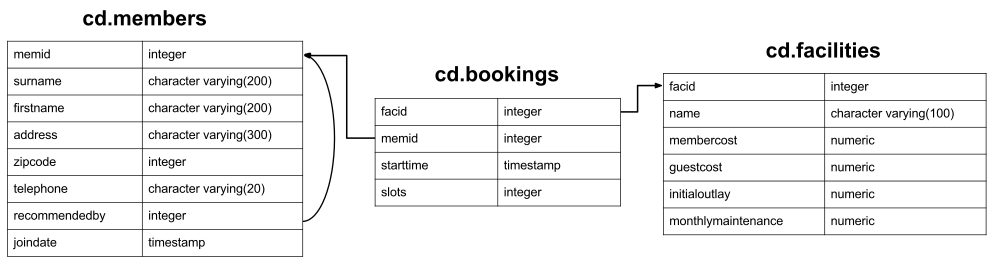
Expected Results
| starttime |
|---|
| Tue Sep 18 2012 09:00:00 GMT+0000 (Coordinated Universal Time) |
| Tue Sep 18 2012 17:30:00 GMT+0000 (Coordinated Universal Time) |
| Tue Sep 18 2012 13:30:00 GMT+0000 (Coordinated Universal Time) |
| Tue Sep 18 2012 20:00:00 GMT+0000 (Coordinated Universal Time) |
| Wed Sep 19 2012 09:30:00 GMT+0000 (Coordinated Universal Time) |
| Wed Sep 19 2012 15:00:00 GMT+0000 (Coordinated Universal Time) |
| Wed Sep 19 2012 12:00:00 GMT+0000 (Coordinated Universal Time) |
| Thu Sep 20 2012 15:30:00 GMT+0000 (Coordinated Universal Time) |
| Thu Sep 20 2012 11:30:00 GMT+0000 (Coordinated Universal Time) |
| Thu Sep 20 2012 14:00:00 GMT+0000 (Coordinated Universal Time) |
| Fri Sep 21 2012 10:30:00 GMT+0000 (Coordinated Universal Time) |
| Fri Sep 21 2012 14:00:00 GMT+0000 (Coordinated Universal Time) |
| Sat Sep 22 2012 08:30:00 GMT+0000 (Coordinated Universal Time) |
| Sat Sep 22 2012 17:00:00 GMT+0000 (Coordinated Universal Time) |
| Sun Sep 23 2012 08:30:00 GMT+0000 (Coordinated Universal Time) |
| Sun Sep 23 2012 17:30:00 GMT+0000 (Coordinated Universal Time) |
| Sun Sep 23 2012 19:00:00 GMT+0000 (Coordinated Universal Time) |
| Mon Sep 24 2012 08:00:00 GMT+0000 (Coordinated Universal Time) |
| Mon Sep 24 2012 16:30:00 GMT+0000 (Coordinated Universal Time) |
| Mon Sep 24 2012 12:30:00 GMT+0000 (Coordinated Universal Time) |
| Tue Sep 25 2012 15:30:00 GMT+0000 (Coordinated Universal Time) |
| Tue Sep 25 2012 17:00:00 GMT+0000 (Coordinated Universal Time) |
| Wed Sep 26 2012 13:00:00 GMT+0000 (Coordinated Universal Time) |
| Wed Sep 26 2012 17:00:00 GMT+0000 (Coordinated Universal Time) |
| Thu Sep 27 2012 08:00:00 GMT+0000 (Coordinated Universal Time) |
| Fri Sep 28 2012 11:30:00 GMT+0000 (Coordinated Universal Time) |
| Fri Sep 28 2012 09:30:00 GMT+0000 (Coordinated Universal Time) |
| Fri Sep 28 2012 13:00:00 GMT+0000 (Coordinated Universal Time) |
| Sat Sep 29 2012 16:00:00 GMT+0000 (Coordinated Universal Time) |
| Sat Sep 29 2012 10:30:00 GMT+0000 (Coordinated Universal Time) |
| Sat Sep 29 2012 13:30:00 GMT+0000 (Coordinated Universal Time) |
| Sat Sep 29 2012 14:30:00 GMT+0000 (Coordinated Universal Time) |
| Sat Sep 29 2012 17:30:00 GMT+0000 (Coordinated Universal Time) |
| Sun Sep 30 2012 14:30:00 GMT+0000 (Coordinated Universal Time) |
Your Answer
Your Results
Loading database...
Answers and Discussion
select bks.starttime
	from
		cd.bookings bks
		inner join cd.members mems
			on mems.memid = bks.memid
	where
		mems.firstname='David'
		and mems.surname='Farrell';
The most commonly used kind of join is the INNER JOIN. What this does is combine two tables based on a join expression - in this case, for each member id in the members table, we're looking for matching values in the bookings table. Where we find a match, a row combining the values for each table is returned. Note that we've given each table an alias (bks and mems). This is used for two reasons: firstly, it's convenient, and secondly we might join to the same table several times, requiring us to distinguish between columns from each different time the table was joined in.
Let's ignore our select and where clauses for now, and focus on what the FROM statement produces. In all our previous examples, FROM has just been a simple table. What is it now? Another table! This time, it's produced as a composite of bookings and members. You can see a subset of the output of the join below:

For each member in the members table, the join has found all the matching member ids in the bookings table. For each match, it's then produced a row combining the row from the members table, and the row from the bookings table.
Obviously, this is too much information on its own, and any useful question will want to filter it down. In our query, we use the start of the SELECT clause to pick columns, and the WHERE clause to pick rows, as illustrated below:

That's all we need to find David's bookings! In general, I encourage you to remember that the output of the FROM clause is essentially one big table that you then filter information out of. This may sound inefficient - but don't worry, under the covers the DB will be behaving much more intelligently :-).
One final note: there's two different syntaxes for inner joins. I've shown you the one I prefer, that I find more consistent with other join types. You'll commonly see a different syntax, shown below:
select bks.starttime
        from
                cd.bookings bks,
                cd.members mems
        where
                mems.firstname='David'
                and mems.surname='Farrell'
                and mems.memid = bks.memid;
This is functionally exactly the same as the approved answer. If you feel more comfortable with this syntax, feel free to use it!